Herb
Arnica
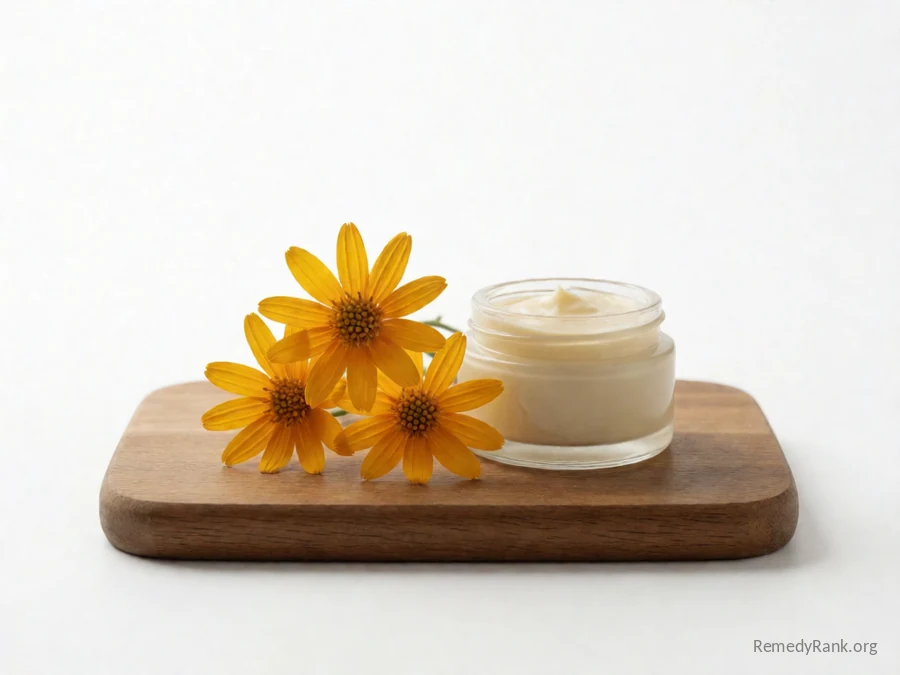
A mountain daisy used in creams and gels on unbroken skin to ease bruises, sprains, and muscle soreness — for external use only.
 ⤢
⤢📊 How it ranks (our editor score) — 72/100Tap to see the breakdown
🌱 What it is
Arnica is a bright yellow daisy-like flower that grows in mountain meadows across Europe and North America. For generations, people have made its blossoms into creams, gels, and oils to rub onto sore muscles and bruises. It is strictly a topical herb in its plant form — the whole point is that it stays on the skin's surface, never inside the body.
📜 Where it comes from
Arnica grows wild in mountain meadows across Europe and North America and has been used for centuries by European folk healers, particularly in the Alps, as a topical remedy for bruises, sprains, and sore muscles after falls or hard labor. It became a staple of German traditional medicine and later entered homeopathic practice in the 19th century. Its use has always been external, since the plant is considered too irritating and potentially toxic to take by mouth.
✨ Why it's good for you
- Traditionally used to support comfort around everyday bumps, bruises, and sore muscles when applied to unbroken skin
- Traditionally used to support a sense of ease after overexertion or a minor knock
- Traditionally used to support the skin's own recovery process after light strain
- Traditionally used to support a soothing after-workout rub-down
🥄 How to use it
Apply arnica cream, gelA cool, jelly-like preparation that soothes and moisturizes skin. How to make a gel →, or ointmentA soft, spreadable skin preparation, a little thicker than a cream. How to make an ointment → to the sore or bruised area on intact skin, two or three times a day. It must never be swallowed in herbal (non-homeopathic) form.
How much: Topically, apply a thin layer of cream or gelA cool, jelly-like preparation that soothes and moisturizes skin. How to make a gel → to the affected area two or three times daily. It is for external use only — never swallow the herbal preparation.
Why it works: TopicalSomething you put on your skin rather than swallow. More → for sore muscles and bruises.
Show full details & how to prepare it
Arnica is a cheerful yellow daisy of mountain meadows, and for centuries its flowers have been turned into creams and ointments to rub on bruises, sprains, and aching muscles. Its compounds, applied to the skin over a fresh bruise or strained muscle, are traditionally used to ease swelling and tenderness.
The one firm rule with arnica is direction: on the skin, yes; swallowed as an herbA plant, or part of one, used for flavor, food, or gentle health support. More →, never — it is genuinely poisonous taken internally in herbal strength. (The tiny homeopathic pellets are a different, extremely dilute product.) Keep it to unbroken skin, away from open cuts, and stop if it irritates.
Ways to prepare it
⚠️ Cautions
- Do not take arnica internally as an herb — it is toxic when swallowed; only homeopathic pellets, which are extremely dilute, are meant to be taken by mouth.
- Never apply it to broken skin or open wounds, and stop if a rash develops; avoid in pregnancy.
📚 Learn more
🌿 Deeper natural detail
🩺 The conventional view
💬 Ask Remy about Arnica
📚 Resource confidence
Based on mentions in health references
Your vote is saved. Source endorsement totals come from books and studies (+7 per book, +5 per article). You can change your vote anytime from this device.
💬 Comments & experiences
Share what worked for you — and reply or 👍 like the experiences that resonate. Comments get a quick review before they appear publicly, to keep things safe and honest. Please don't make medical claims.
💚 Have an experience to share? Create a free account to join the conversation — your words might be exactly what someone else needs. Reading is always open to everyone.
Know a remedy like this?
Share a structured suggestion and our team will review it for the site.
Suggest a similar remedy