Vegetable
Kale
A hardy dark leafy green packed with iron, calcium, vitamin K, and antioxidants for bones, blood, and overall vitality.
 ⤢
⤢📊 How it ranks (our editor score) — 85/100Tap to see the breakdown
🌱 What it is
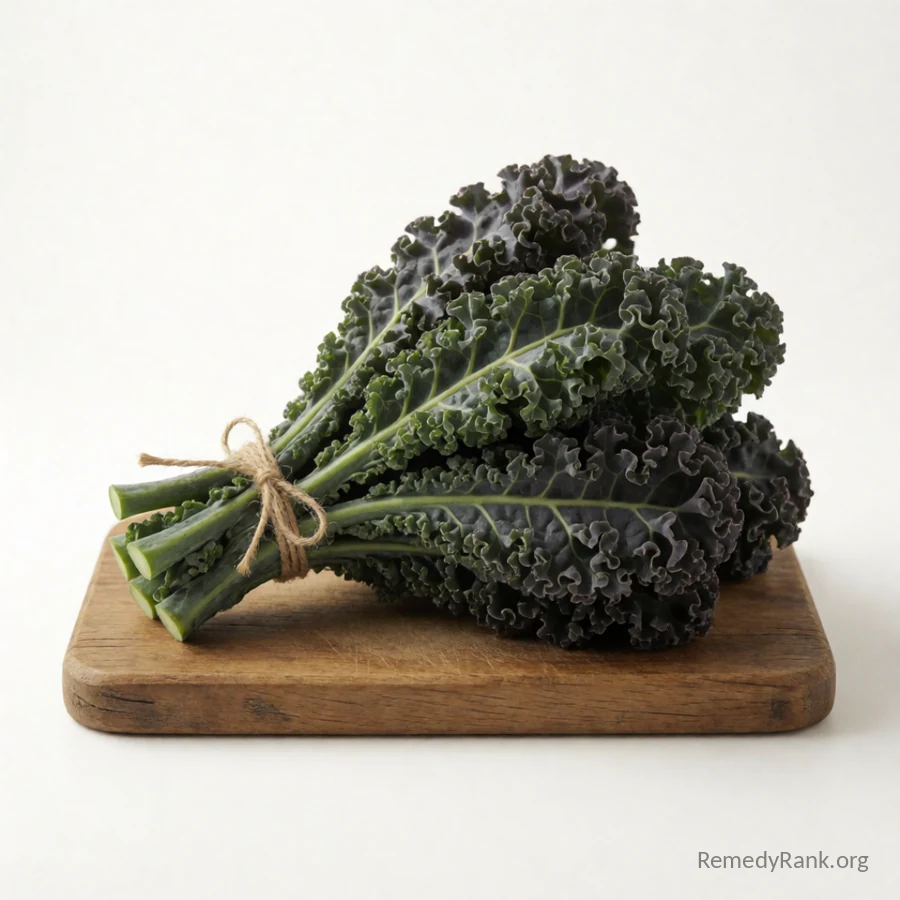
Kale is a sturdy, curly-leafed member of the cabbage family, dark green and full of vitamins, minerals, and plant antioxidants.
📜 Where it comes from
Kale has been grown since ancient Greco-Roman times as a hardy, cold-tolerant relative of cabbage, and it remained a staple vegetable through medieval Europe when other greens were scarce in winter. It fell out of common use for a time before a resurgence in the late 20th and early 21st centuries as nutrition science highlighted its density of vitamins and minerals.
✨ Why it's good for you
- May help support strong bones through vitamin K and calcium
- May help support healthy blood through iron and vitamin K
- May help support the immune system through vitamin C
- May help support healthy inflammation levels
🥗 Nutrition
Per 1 cup chopped, raw (67 g) · about 33 calories
- Vitamin K: 547 mcg
- Vitamin C: 80.4 mg
- Vitamin A: 206 mcg RAE
- Calcium: 90.5 mg
Source: USDA FoodData Central
🥄 How to use it
Massage raw kale with a little oil and lemon for salads, or sauté and add to soups; cooking softens it and a little vitaminA natural substance your body needs in small amounts to stay healthy, like vitamin C or D. More →-C food alongside helps you absorb its iron.
How much: A serving several times a week, raw or cooked.
Why it works: As a whole food dense in vitamin K, calcium, and iron, kale is thought to support bone strength and healthy blood in the same straightforward way any nutrient-rich vegetable does, by supplying building blocks the body uses every day.
Show full details & how to prepare it
Kale is one of the most nutrient-dense leafy greens, loaded with iron and calcium for the blood and bones, vitamin K, and a wealth of antioxidants. Pairing it with a vitaminA natural substance your body needs in small amounts to stay healthy, like vitamin C or D. More →-C food helps the body absorb its plant iron.
Ways to prepare it
🔬 Let's get technical
The scientific view, plainly reported. Hover a dotted word for its meaning.
What's in it
Kale is notably dense in vitamin K1 (), vitamin C, and provitamin-A such as and , along with calcium, though its calcium is bound with oxalates that somewhat limit absorption compared to dairy sources. It also contains , sulfur-containing compounds characteristic of the brassica family, which are converted to when the plant tissue is damaged, such as by chewing or chopping.
Mechanism of action
Vitamin K1 is a required cofactor for the liver enzyme that activates clotting factors II, VII, IX, and X through a process called , which is why individuals on certain anticoagulant medications are advised by clinicians to keep vitamin-K intake consistent rather than avoiding it. and related are selectively deposited in the of the retina, where they are thought to filter high-energy blue light and act as local antioxidants, a mechanism studied in relation to age-related macular degeneration. are converted by the plant's own myrosinase enzyme, released on cutting or chewing, into such as sulforaphane, compounds studied for their ability to induce the body's phase II detoxification enzymes via the Nrf2 signaling pathway. Kale's calcium, while present in meaningful amounts, is partly bound by oxalic acid into a less soluble complex, reducing the fraction actually absorbed in the gut relative to its total content.
Current pharmacological applications
Kale's nutrient density is well documented through standard nutritional analysis, and diets high in cruciferous vegetables including kale are consistently associated in large cohort studies with lower rates of several chronic diseases, though such associational data cannot isolate kale's individual contribution from overall dietary pattern. and intake is studied specifically in relation to eye health, including in the large AREDS2 trial framework, though that trial used concentrated supplement doses rather than food-level kale intake. and research, much of it or animal-based, is an active but still maturing area rather than one with large confirmatory human trials specific to kale.
Every underlined word is collected on the technical glossary.
⚠️ Cautions
- A whole food, very nourishing; high in vitamin K, so those on blood thinners (warfarin) should keep intake steady and consistent.
- Large raw amounts may affect the thyroid in those prone — cooking reduces this.
- Those prone to kidney stones should be moderate (it contains oxalate).
📚 Learn more
🌿 Deeper natural detail
Curated links coming for this one.
🩺 The conventional view
💬 Ask Remy about Kale
📚 Resource confidence
Based on mentions in health references
Your vote is saved. Source endorsement totals come from books and studies (+7 per book, +5 per article). You can change your vote anytime from this device.
💬 Comments & experiences
Share what worked for you — and reply or 👍 like the experiences that resonate. Comments get a quick review before they appear publicly, to keep things safe and honest. Please don't make medical claims.
💚 Have an experience to share? Create a free account to join the conversation — your words might be exactly what someone else needs. Reading is always open to everyone.
Know a remedy like this?
Share a structured suggestion and our team will review it for the site.
Suggest a similar remedy