Vegetable
Garlic
A pungent bulb traditionally used to support immunity and healthy circulation.
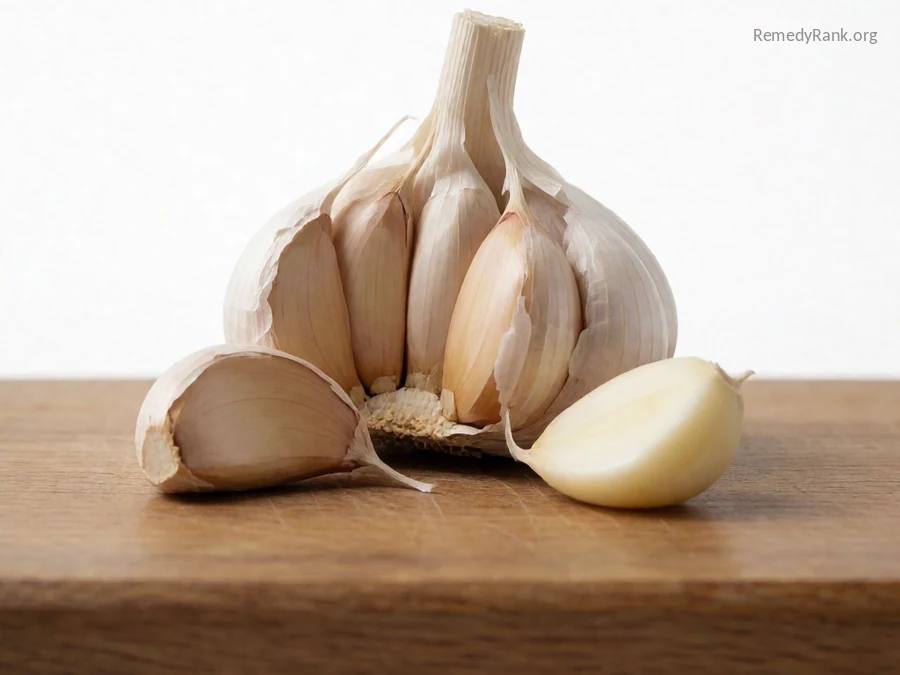 ⤢
⤢📊 How it ranks (our editor score) — 79/100Tap to see the breakdown
🌱 What it is
Garlic is a strong-smelling bulb in the onion family. The same compounds that give it that powerful smell are the ones that may help your body.
📜 Where it comes from
Garlic has one of the longest medicinal histories of any food, used by ancient Egyptian laborers for stamina and referenced in Greco-Roman medical writings, including those attributed to Hippocrates, for infections and the heart. Traditional Chinese Medicine and folk healers across the Middle East and Europe likewise turned to garlic for colds and circulation. It traveled into nearly every household kitchen as both food and medicine, a dual role it still holds today.
✨ Why it's good for you
- May help support a healthy immune system
- Often linked with healthy blood pressure and circulation
- Adds big flavor with almost no calories
🥗 Nutrition
Per 3 cloves (9g) · about 13 calories
- Manganese 8% DV
- Vitamin B6 6% DV
- Vitamin C 5% DV
- Allicin compounds
Source: USDA FoodData Central
🥄 How to use it
Crush a clove, let it rest 10 minutes, then eat raw in food or lightly cooked.
How much: A common food amount is 1–2 fresh cloves a day. If using an aged-garlic capsuleDried, powdered herb packed into a swallowable shell for a measured dose. How to make a capsule → for blood pressure, follow the label (often 600–1,200 mg a day, split into doses). Take with food to be gentler on the stomach.
Why it works: Antimicrobial; may fight infections common in CF.
Show full details & how to prepare it
Garlic has been valued as both food and medicine for thousands of years, and modern study keeps finding reasons it earned that reputation. The key is a compound called allicin, which forms only when a raw clove is crushed or chopped and then left to sit for about ten minutes before heating. That short rest lets the helpful compound develop fully — chop, wait, then cook.
Garlic is best known for gently supporting healthy circulation and blood pressure, and for lending the immune system a hand during the cold-and-flu season. Its natural compounds also discourage some germs, which is why a clove in a warming soup feels so fitting at the first sniffle.
Raw garlic is the most potent but can bite an empty stomach, so most people do best taking it with food. Garlic can mildly thin the blood, so keep to normal food amounts if you take blood thinners or have surgery coming up, and introduce it slowly if your stomach is sensitive.
Ways to prepare it
🔬 Let's get technical
The scientific view, plainly reported. Hover a dotted word for its meaning.
What's in it
Fresh garlic's signature bioactivity begins with , an odorless sulfur-containing amino-acid derivative stored inside the bulb's cells. Crushing or chewing ruptures the cell walls and brings alliin into contact with the enzyme , which rapidly converts it into , an unstable but potent that breaks down further into , diallyl trisulfide, and ajoene. Aged or processed garlic preparations trade some of this reactive allicin for more stable derivatives, which changes their chemical profile and, potentially, their effects.
Mechanism of action
and its breakdown products are thought to act on several fronts at once. and animal studies suggest these inhibit and support smooth-muscle relaxation, effects that have been proposed as contributors to garlic's traditional association with circulatory support. Some research points to a mild -inhibiting action on lipid metabolism, broadly analogous in mechanism (though far weaker in magnitude) to prescription statin drugs, alongside a reduction of LDL oxidation attributed to the compounds' antioxidant activity. Allicin also shows direct activity against a range of bacteria in laboratory settings, and some data suggest garlic-derived compounds can stimulate activity and proliferation, though these immune effects are and vary widely between preparations.
Current pharmacological applications
Garlic supplements have been studied most extensively for cardiovascular markers, with meta-analyses reporting small reductions in total and and modest blood-pressure effects in people with hypertension; a 2022 research review looking at immune outcomes identified only two qualifying studies, both limited by small sample size. Garlic-derived such as diallyl trisulfide and ajoene remain of interest to researchers studying and anticancer mechanisms in laboratory and animal models, though this line of research has not yet translated into established clinical applications. NCCIH notes that garlic does not appear to reduce stomach cancer risk and that evidence for colorectal cancer risk reduction remains uncertain.
Every underlined word is collected on the technical glossary.
⚠️ Cautions
- Raw garlic can irritate the stomach.
- May thin the blood — moderate if on blood thinners.
📚 Learn more
🌿 Deeper natural detail
🩺 The conventional view
💬 Ask Remy about Garlic
📚 Resource confidence
Based on mentions in health references
Your vote is saved. Source endorsement totals come from books and studies (+7 per book, +5 per article). You can change your vote anytime from this device.
💬 Comments & experiences
Share what worked for you — and reply or 👍 like the experiences that resonate. Comments get a quick review before they appear publicly, to keep things safe and honest. Please don't make medical claims.
💚 Have an experience to share? Create a free account to join the conversation — your words might be exactly what someone else needs. Reading is always open to everyone.
Know a remedy like this?
Share a structured suggestion and our team will review it for the site.
Suggest a similar remedy