Herb
Comfrey
A traditional 'knitbone' herb applied externally to support skin and tissue healing.
🛑 RemedyRank warns against this
Safe on unbroken skin for a short while; taken internally it causes irreversible liver damage.
This page exists so the reasons are written down plainly, not because the practice is recommended. Nothing is sold here. If a doctor has prescribed something for a diagnosed condition, follow their guidance — that is a decision between you and them, and it is a different thing from trying this at home.
 ⤢
⤢📊 How it ranks (our editor score) — 56/100Tap to see the breakdown
🌱 What it is
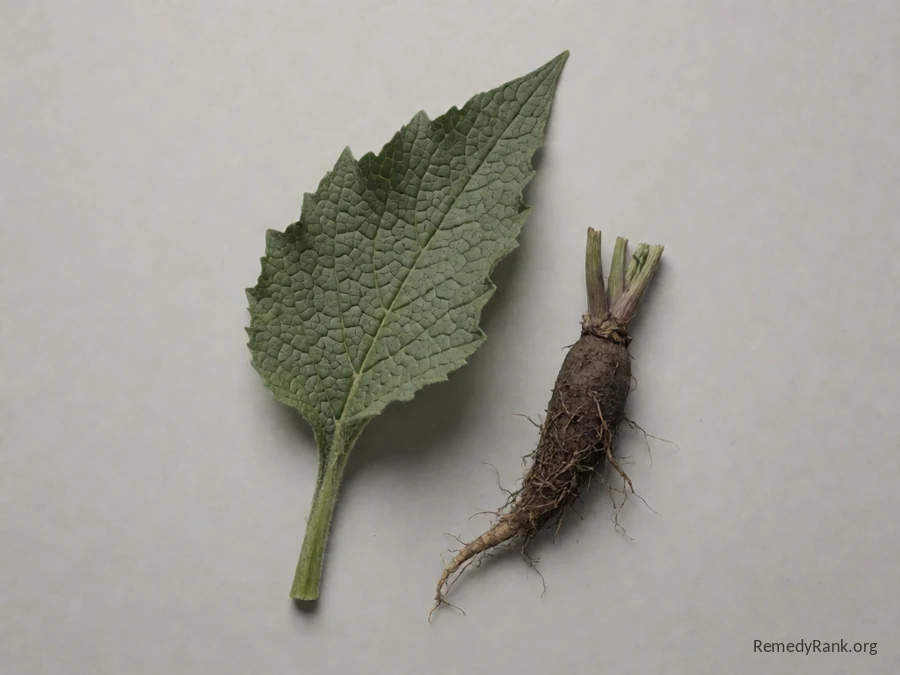
Comfrey is a leafy herb containing allantoin, historically applied to bruises, sprains, and closed wounds to support healing.
📜 Where it comes from
Comfrey, sometimes called knitbone, has been used since ancient Greek and Roman times, including by physicians such as Dioscorides, to help mend broken bones and heal wounds. Medieval European herbalists carried this tradition forward, and comfrey remains a traditional external remedy applied to bruises and closed injuries to support healing.
🥄 How to use it
Apply as a poulticeMashed plant material applied right on the skin. How to make a poultice →, cooled teaA warm drink made by steeping herbs in hot water. How to make a tea → compressA cloth soaked in warm or cold liquid, held on the skin. How to make a compress →, or paste made from crushed fresh or dried leaves directly to unbroken skin, bruises, or closed wounds for 15-20 minutes, a few times daily.
How much: Apply externally for 15-20 minutes, up to 3 times daily; do not take internally.
Why it works: Allantoin and other compounds in comfrey may promote skin cell turnover and support tissue repair when applied externally.
🔬 Let's get technical
The scientific view, plainly reported. Hover a dotted word for its meaning.
What's in it
Comfrey leaf and root contain , , , and , of which the 1,2-unsaturated types are hepatotoxic when absorbed systemically and carcinogenic in animal studies at sufficient exposure; concentrations are substantially higher in the root than in the leaf.
Mechanism of action
promotes proliferation and has been shown to accelerate epithelialization of wound surfaces, which underlies comfrey's traditional 'knitbone' reputation for bruises and minor tissue injury. contributes antioxidant and anti-inflammatory activity at the tissue level, potentially reducing local -mediated swelling. The 1,2-unsaturated , by contrast, are metabolized in the liver to reactive pyrrole intermediates that damage hepatic tissue, characteristically the small hepatic veins, and with prolonged systemic exposure have shown carcinogenic potential in animal studies. Because intact skin limits but does not eliminate absorption of these , modern topical products are typically formulated from pyrrolizidine-alkaloid-reduced or -free plant material and restricted from application to broken skin.
Current pharmacological applications
Comfrey ointments and gels have been tested in randomized trials for topical use on bruises, sprains, and osteoarthritis-related joint pain, with several showing measurable reductions in pain and swelling compared with placebo over short treatment courses. Oral use and application to broken skin are discouraged or restricted by regulatory agencies in a number of countries specifically because of content, illustrating a case where topical evidence is more favorable than the safety profile of internal use.
Every underlined word is collected on the technical glossary.
⚠️ Cautions
- For external use only — comfrey contains pyrrolizidine alkaloids and internal use (tea, capsules) can cause serious liver damage; do not ingest it.
- Do not apply to deep, open, or infected wounds, as it can promote surface healing over an unclean wound.
- Avoid in pregnancy and breastfeeding.
- Limit use to no more than a few weeks at a time on intact or closed-wound skin.
📚 Learn more
🌿 Deeper natural detail
🩺 The conventional view
Curated links coming for this one.
🔎 What this addresses
Where Comfrey fits into a condition's cause-and-symptom picture — some conditions it works on the root cause of, others it mainly soothes.
Eases the symptoms of
For these, it calms the condition without addressing what drives it.
- Eczema — Long used in salves for skin and wound healing; because comfrey can be irritating over broken or weeping skin, it's best kept to short-term use on intact skin.
💬 Ask Remy about Comfrey
📚 Resource confidence
Based on mentions in health references
Your vote is saved. Source endorsement totals come from books and studies (+7 per book, +5 per article). You can change your vote anytime from this device.
💬 Comments & experiences
Share what worked for you — and reply or 👍 like the experiences that resonate. Comments get a quick review before they appear publicly, to keep things safe and honest. Please don't make medical claims.
💚 Have an experience to share? Create a free account to join the conversation — your words might be exactly what someone else needs. Reading is always open to everyone.
Know a remedy like this?
Share a structured suggestion and our team will review it for the site.
Suggest a similar remedy